

Digital Ecosystems and Economic Development
A practical report on how participation, creation, and digital public infrastructure can raise productivity, inclusion, and resilience.

Digital ecosystems—networks of people, organisations, platforms, tools, and rules that enable learning, creation, exchange, and coordination online—can be a major engine of economic development when they are widely accessible and designed for inclusion. Their development impact comes through several reinforcing channels:
Higher productivity via better information flows, process digitisation, and cheaper coordination across markets and supply chains.
Human capital formation through low-cost access to education and “learning-by-doing”, increasingly accelerated by AI-enabled tools.
Entrepreneurship and firm formation as barriers to building products, services, and distribution channels fall (e.g., building websites and applications with modern coding assistants).
Market expansion through e-commerce, platform-enabled trade, and remote services exports.
More effective government and inclusion when core enabling systems—digital identity, payments, and trustworthy data exchange—are provided as Digital Public Infrastructure (DPI).
Greater resilience in shocks (pandemics, climate events, conflict) by enabling continuity of payments, information, and public services.
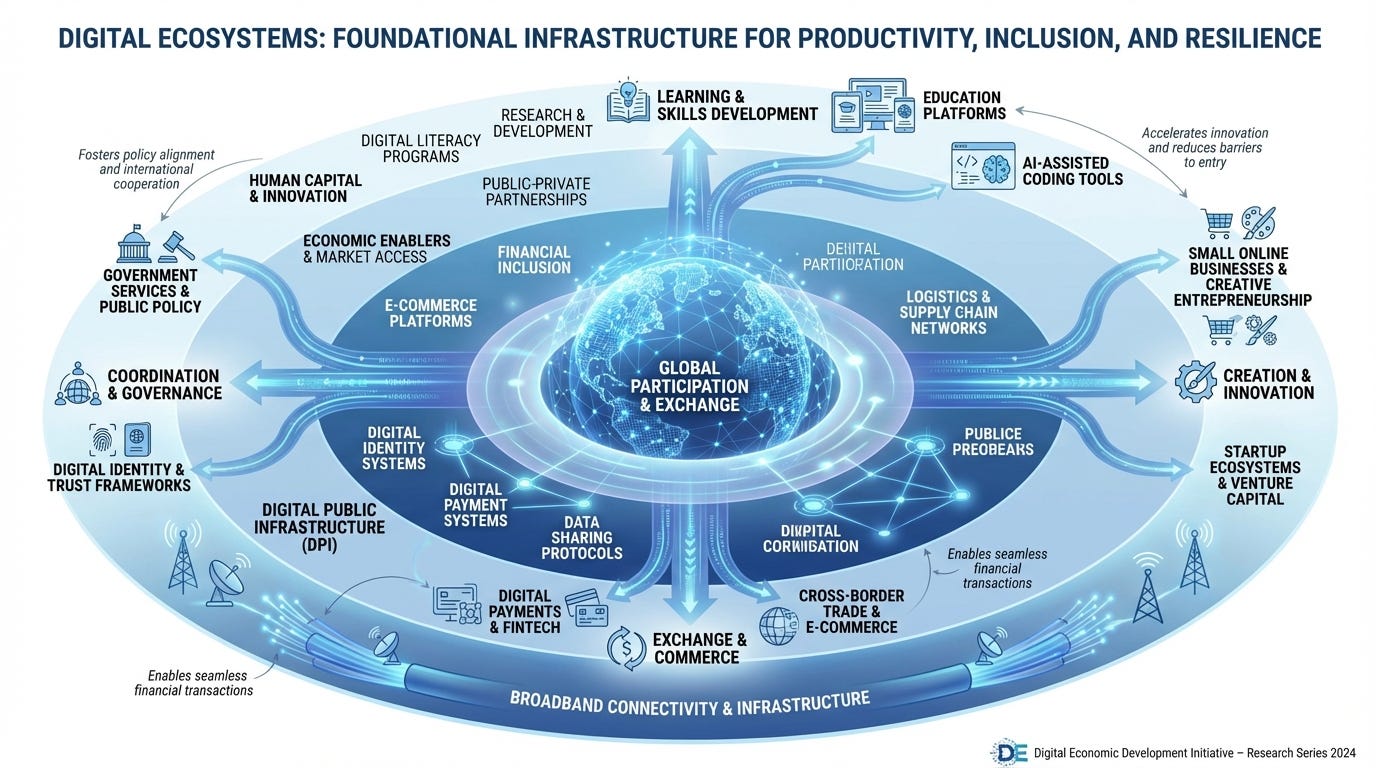
The evidence base supports these channels, but also warns that digital benefits can be uneven unless complemented by skills, regulation, competition policy, and safeguards. The world is increasingly online—around 6 billion people used the internet in 2025—yet 2.2 billion remain offline, and divides in affordability, quality, and skills persist.
1) What is a digital ecosystem?
A digital ecosystem is an interconnected system that enables people and organisations to:
Access knowledge and services (education, health, finance, public services)
Create and contribute (software, websites, media, data, communities)
Exchange value (payments, contracts, marketplaces, labour platforms)
Coordinate and govern (standards, identity, trust, regulation, dispute resolution)
Core layers of a digital ecosystem
Connectivity & devices: broadband/mobile networks, affordability, reliable electricity.
Identity, payments & data rails: DPI that makes transactions and service delivery scalable.
Platforms & marketplaces: e-commerce, app ecosystems, learning platforms, creator platforms.
Tools for production: developer environments, no-code/low-code, AI copilots (e.g., Cursor-like tools), cloud hosting, analytics.
Institutions & rules: competition policy, consumer protection, privacy, cybersecurity, digital trade rules.
Skills & social capital: digital literacy, safety, and the capability to create (not just consume).
A useful development framing is that digital ecosystems function as cognitive and coordination infrastructure: they reduce the cost of learning, transacting, and organising economic activity.
2) Why digital ecosystems matter for economic development
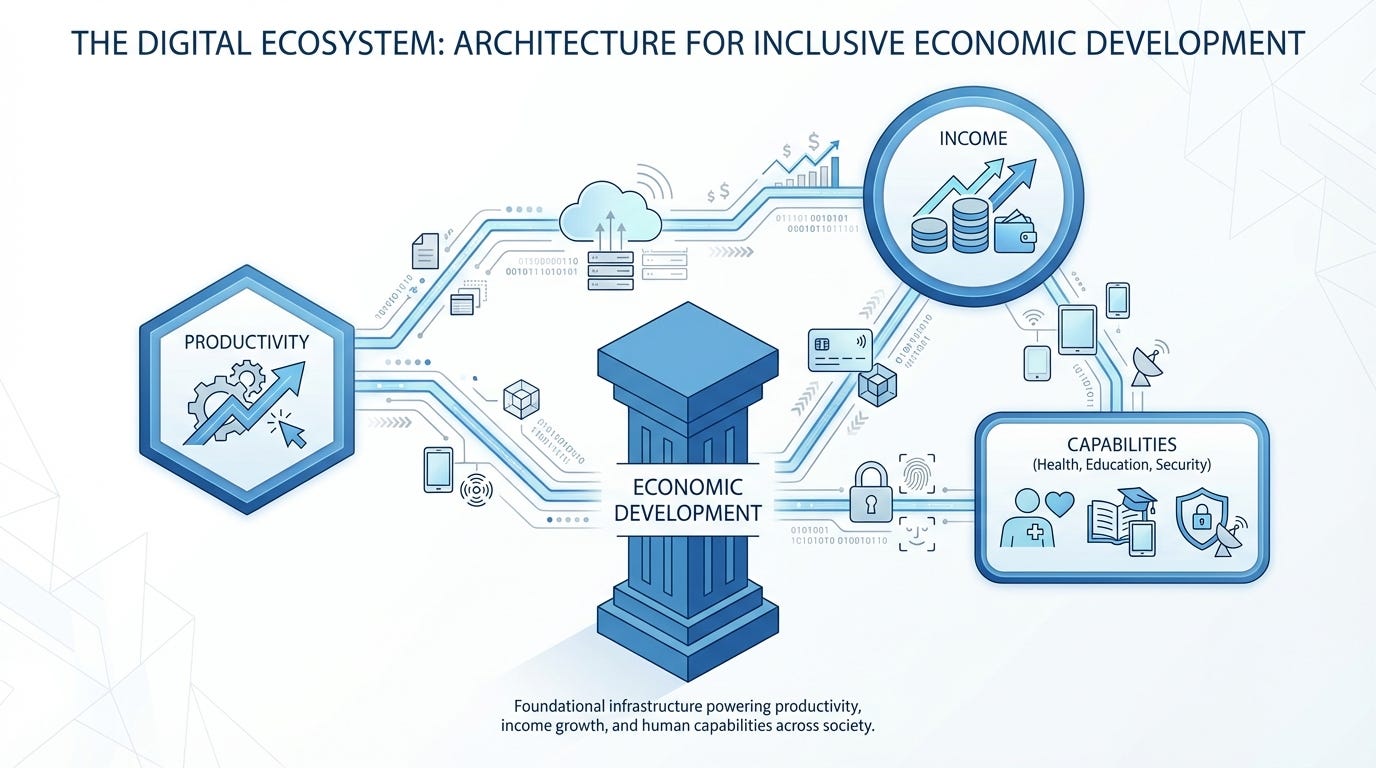
Economic development is, in essence, sustained improvement in productivity, income, and capabilities (health, education, security) across a population. Digital ecosystems influence these through five main mechanisms.
3) Key pathways from digital ecosystems to growth and development
Pathway A: Productivity gains and lower transaction costs
Digital systems reduce “friction” in the economy:
Search costs (finding suppliers, customers, jobs)
Verification costs (identity, credentials, reputation)
Contracting and payment costs
Coordination and logistics costs
Empirically, studies often find positive relationships between broadband expansion and growth, though causality and context matter. A World Bank-compiled review notes estimates where a 10 percentage-point increase in broadband penetration is associated with higher GDP growth, while also cautioning about methodological limits and endogeneity in some results.
More recent academic work also continues to examine the economic benefits of broadband coverage and adoption, reflecting an ongoing research consensus that connectivity can support productivity and growth—especially when paired with adoption and complementary investments.
Development implication: connectivity roll-out is necessary, but not sufficient; adoption, quality, and effective use determine whether productivity gains materialise.
Pathway B: Human capital through education access and “learning-by-building”
Digital ecosystems are especially powerful when they expand education access and enable practical creation.
Education platforms and creator economies can deliver structured learning at low marginal cost.
The most development-relevant shift is from digital consumption to digital production: people learning and then immediately building websites, tools, services, and businesses.
AI-assisted development environments lower barriers to entry, turning motivated learners into “citizen developers” faster than traditional pathways.
The ITU highlights that meaningful connectivity depends not only on access, but also on skills, and notes that more advanced capabilities (including digital content creation) are developing more slowly than basic skills.
Development implication: digital ecosystems can accelerate skill formation—particularly for youth—if education access is paired with tooling, mentorship, and pathways to income.
Pathway C: Entrepreneurship, SME digitisation, and firm creation
When people can cheaply build and distribute:
they can start micro-enterprises (local services, niche commerce, digital freelancing)
SMEs can digitise operations (inventory, payments, customer acquisition)
informal businesses can formalise (through digital payments, records, and identity)
This matters because development is often driven by the growth of more productive firms and the diffusion of better business practices.
However, the World Bank’s “Digital Dividends” framing stresses that while digital technologies can boost growth and service delivery, the dividends may lag or be uneven without the right complements (skills, governance, competition, accountability).
Development implication: ecosystems that encourage creation and market participation (not just connectivity) are more likely to generate broad-based employment and income gains.
Pathway D: Market access, trade, and platform-enabled commerce
Digital ecosystems expand the reachable market for firms and workers:
local sellers can reach national/international buyers
remote services exports become viable (design, software, marketing, analytics)
platforms create matching markets for labour and services
UNCTAD reports business e-commerce sales (across 43 countries representing ~three quarters of global GDP) rising nearly 60% from 2016 to 2022, reaching $27 trillion—a signal of the scale of digitally mediated commerce.
Development implication: digital ecosystems can accelerate structural transformation by enabling firms to reach larger markets—if logistics, payments, trust, and consumer protection keep pace.
Pathway E: Inclusion and state capacity via Digital Public Infrastructure
A growing consensus is that foundational “rails” matter for inclusion and efficiency—particularly in low- and middle-income countries.
Digital Public Infrastructure (DPI) is typically described as foundational systems that enable secure, seamless interaction among people, businesses, and government—especially:
digital identity
digital payments
trusted data exchange
The World Bank similarly highlights DPI as common systems such as digital identity/signatures, payments, and data sharing—while emphasising principles like inclusion, modularity, user-centricity, privacy-by-design, and governance.
Why DPI matters for development
Makes service delivery scalable (benefits, healthcare, licensing, education)
Reduces leakage and improves targeting in government payments
Enables competition and innovation by standardising rails (so firms can build on top)
The IMF’s analysis of India’s “stacked” DPI approach argues that a foundation of unique digital ID, payments, and data exchange can support transformation and inclusive growth, fostering innovation and competition and improving public finance administration.
The World Bank reports supporting over 60 countries in issuing inclusive, secure digital IDs to hundreds of millions of people and building other DPI elements such as data sharing and government-to-person payments.
Development implication: DPI can turn fragmented programmes into platforms—improving inclusion, lowering costs, and enabling private-sector innovation on top of public rails.
4) Participation at scale: why “create and contribute” changes the equation
A digital ecosystem becomes developmentally transformative when large numbers of people can:
learn (education access)
build (websites, apps, content, services)
transact (digital payments)
earn (local and global customers)
reinvest (in further education, tools, and businesses)
Tools that enable rapid creation—such as AI-assisted coding and site-building—compress the path from learning to income. For development, this is critical because it increases the rate of:
micro-enterprise formation
local solution-building (tailored to real constraints)
diffusion of best practices through demonstration effects
This is one reason “skills” must be defined as productive capability, not just basic literacy.
5) Constraints and risks that can reduce (or reverse) development gains
Digital ecosystems are not automatically beneficial.
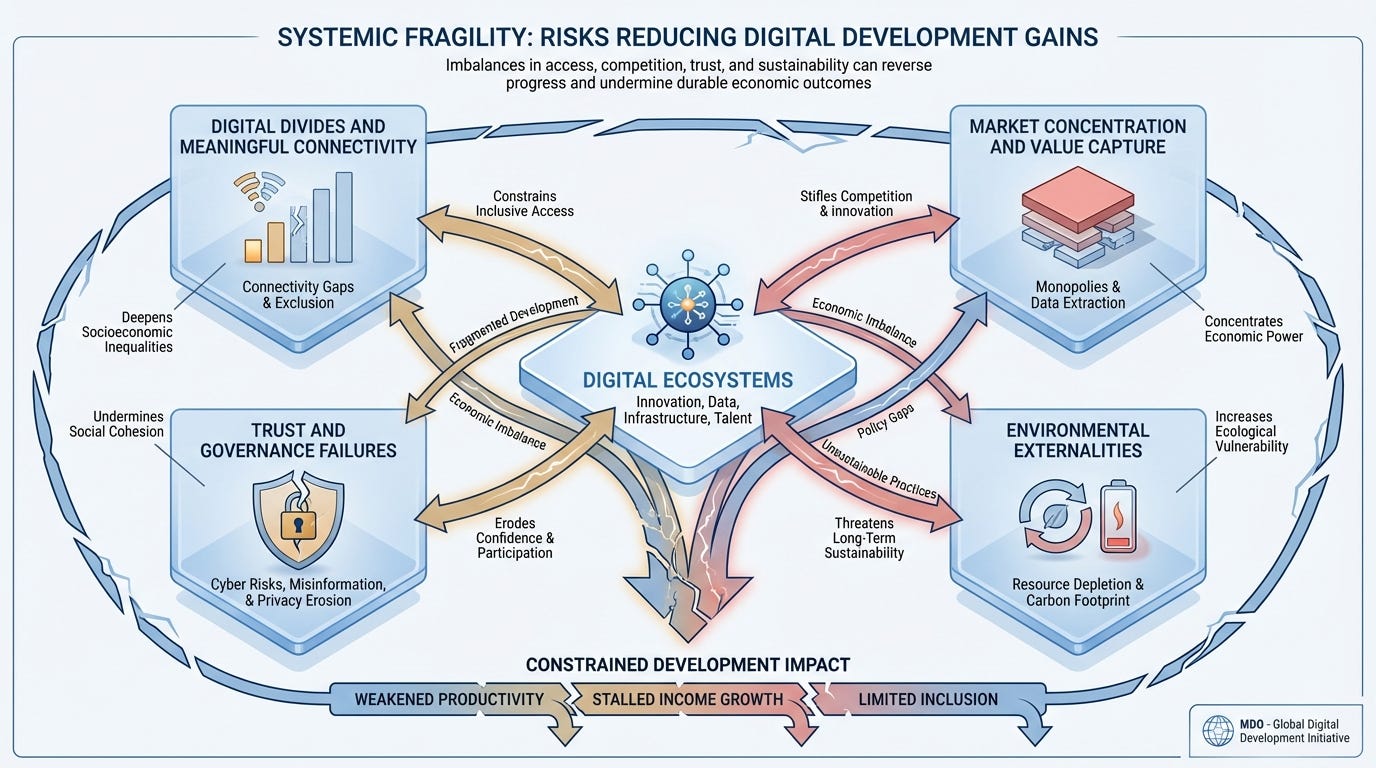
Common failure modes include:
Digital divides and “meaningful connectivity”
Even as internet use grows, divides remain stark by income group, geography, and gender. In 2025, the ITU reported:
~94% internet use in high-income countries vs 23% in low-income countries
urban vs rural gaps (e.g., 85% vs 58%)
affordability and skills constraints persisting
5G coverage highly uneven (e.g., far higher in high-income than low-income contexts)
The OECD likewise stresses that affordable, high-quality broadband is vital and that spatial divides (rural/urban) persist, requiring measurement and targeted policy.
Market concentration and value capture
Platform markets can concentrate power and profits, limiting local value capture if:
domestic firms cannot compete
data and payment rails are closed or monopolised
interoperability is weak
Trust, safety, and governance failures
cybercrime and fraud can deter adoption
weak consumer protection can harm households
surveillance risks can undermine rights and trust, reducing participation
Environmental externalities
UNCTAD underscores that digitalisation has a growing material footprint, noting (among other indicators) significant electricity use attributable to digital devices, data centres, and ICT networks, and calling for a more circular digital economy and stronger alignment between digital and environmental policies.
Development implication: “growth at any cost” digitalisation can deepen inequality, extract value, or increase environmental burdens—especially in countries that export raw materials and import higher value devices.
6) What governments and development partners can do
Priority 1: Build affordable, reliable connectivity
Focus not only on coverage, but on quality, reliability, and affordability.
Measure “meaningful connectivity” (speed, reliability, price, device access, skills), aligning with the ITU emphasis on quality and affordability gaps.
Priority 2: Invest in DPI as shared rails
Implement or strengthen identity, payments, and data exchange layers with strong safeguards.
Design for interoperability to avoid fragmented silos and to encourage competition and innovation.
Priority 3: Treat “skills” as productive capability
Move beyond basic digital literacy to include:
online safety and problem-solving
practical creation (web building, app prototyping, digital marketing)
pathways to income (apprenticeships, client marketplaces, credentialing)
This aligns with the ITU’s observation that advanced capabilities develop more slowly than basic skills—yet are essential for meaningful participation.
Priority 4: Enable SME digitisation and local entrepreneurship
Incentivise adoption of digital payments and record-keeping
Improve access to finance for small firms using digital transaction histories
Support local developer/creator communities (incubators, micro-grants, procurement)
Priority 5: Update regulation for trust, competition, and inclusion
consumer protection and dispute resolution
privacy and data protection
cybersecurity capacity
competition policy to prevent anti-competitive platform behaviour
The World Bank’s “Digital Dividends” logic is that digital adoption alone is not enough; complements in regulation, skills, and institutions shape whether benefits are broad-based.
Priority 6: Align digitalisation with environmental sustainability
adopt circular economy approaches (durability, repairability, recycling)
improve transparency on environmental impacts
regulate data centre energy/water use where relevant
UNCTAD explicitly calls for linking environmental and digital policies more closely.
7) A practical maturity model for building development-oriented digital ecosystems
Stage 1 — Foundations
connectivity + affordability
basic digital skills
initial DPI components (ID, payments)
Stage 2 — Adoption
government services digitised (G2P payments, licensing)
SMEs adopt payments + basic digital operations
trust and consumer protections implemented
Stage 3 — Creation
widespread ability to build (websites, apps, content)
local tech/services sector growth
export of remote services begins
Stage 4 — Platform and resilience
interoperable rails enable multiple competing providers
data exchange supports better public services and private innovation
ecosystem supports crisis continuity (payments/services/information)
Across all stages: governance and safeguards (privacy, inclusion, security, competition) are not optional add-ons; they determine adoption and long-run legitimacy.
Conclusion
Digital ecosystems can contribute substantially to economic development by raising productivity, accelerating human capital formation, enabling entrepreneurship, expanding markets, and strengthening inclusion through DPI. The greatest gains occur when ecosystems support not only access and consumption, but also creation and contribution—so people can learn, build, transact, and earn.
The main strategic lesson from global evidence is that digital transformation is a system, not a single investment: connectivity, skills, DPI, trust, and competition must move together for “digital dividends” to become broad-based and durable.