

How Technology Diffusion Can Save the World
Why connecting the next 2.6 billion people is the leverage point for solving climate, poverty, governance, and every other global challenge.

I. The Paradox of Solved Problems
Humanity has already solved most of its hardest problems — at least in principle.
Clean energy is now cheaper than fossil fuels. Vaccines exist for nearly every major infectious threat. Agricultural yields are high enough to feed the world. Democratic governance models are well‑documented. The knowledge is there.
And yet: 700 million people still live in extreme poverty. Emissions continue to rise. State capacity is collapsing in dozens of countries. The gap between having a solution and deploying it is now the defining challenge of the 21st century.
That gap has a name: the diffusion problem.
This is not a story about innovation. It is a story about reach. About the 2.6 billion people still offline. About the billions more who are nominally connected but excluded from the digital economy, the knowledge commons, and the institutions that rely on both.
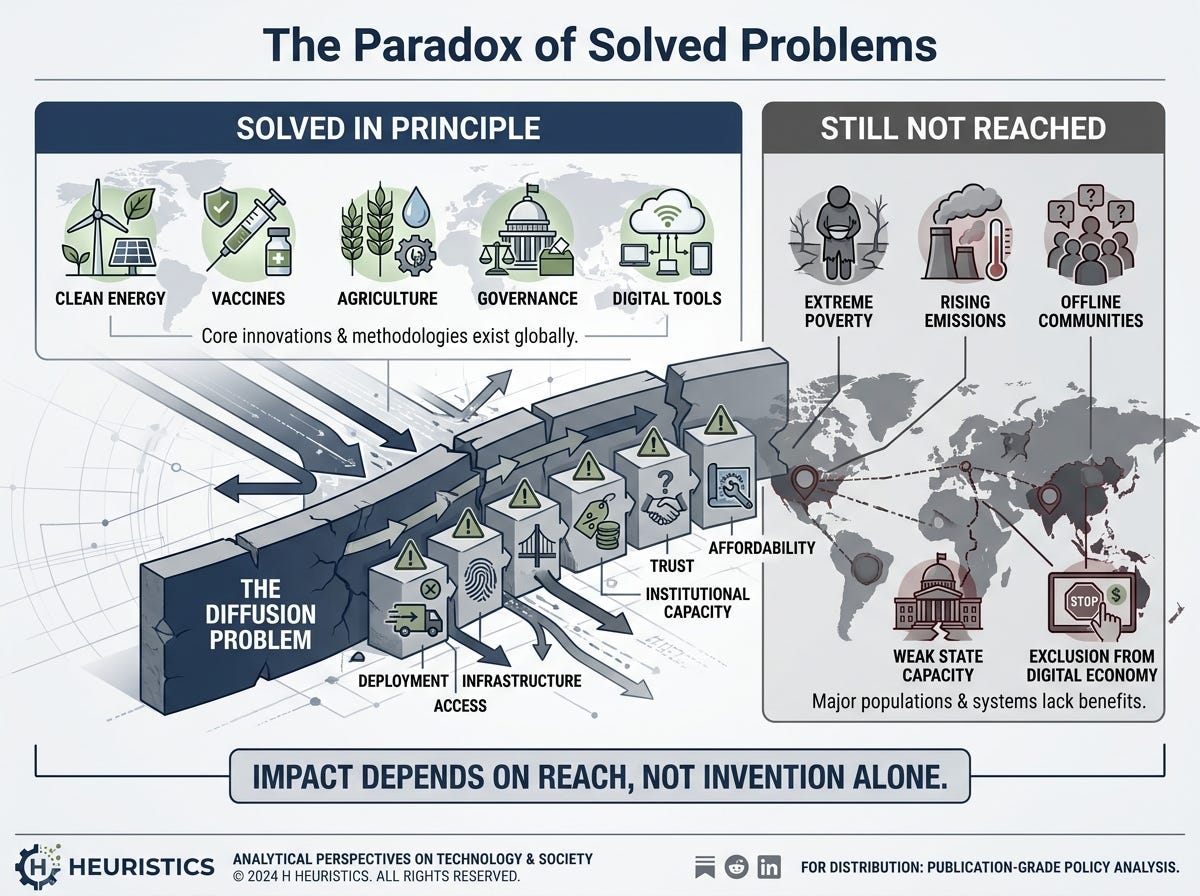
Technology diffusion — the spread of connectivity, tools, and digital capability — is not a development project. It is civilisational infrastructure. And getting it right is the precondition for solving almost everything else.
II. What Diffusion Actually Means
We confuse invention with impact. They are not the same.
The world invests trillions in optimisation — faster chips, better models, more efficient solar panels — and comparatively little in diffusion. But the H Heuristics framework is blunt:
Impact = Optimisation × Diffusion × Use
A perfect technology deployed to 10% of the people who need it has 10% of its potential impact. Optimisation is a multiplier on a diffusion base.
Today, that base is fractured. Internet use is above 90% in high‑income countries but only 27% in low‑income ones. Among people in extreme poverty, just 16% are online. The reasons are structural: infrastructure costs, unreliable energy, affordability barriers, language gaps, digital illiteracy, and the absence of digital ID systems.
Closing this gap triggers two massive cascades — one economic, one epistemic — that reshape everything from climate to governance to scientific progress.
III. Channel One — The Economic Cascade
Connectivity → Skills → Income → Clean Transition
A. The Income Lift
Connectivity lowers transaction costs, opens access to markets, and allows small firms to compete globally. For developing countries, the leapfrogging advantage is real: they face fewer legacy constraints and can adopt new paradigms faster once connected.
B. Remote Work and Wage Arbitrage
Remote work is a $12 trillion global opportunity by 2030. Over half of remote roles pay more than $42,500 — a life‑changing income in low‑income contexts. The gig economy is already a preview: 545 platforms across 186 countries, with low‑ and middle‑income countries accounting for 40% of traffic.
C. Human Capital Formation
MOOCs and digital learning are the cheapest mechanism for mass upskilling in history. The constraint is not platform availability — it’s digital readiness. In Peru, 43% of adults have no computer experience. The OECD average is 16%.
D. Income Growth Unlocks the Clean Transition
Solar is now 41% cheaper than fossil fuels; offshore wind is 53% cheaper. The bottleneck is not cost — it’s capital access. Only 7% of global clean‑energy investment reaches low‑income countries.
As incomes rise through digital participation, households can afford clean options, and governments gain tax capacity to invest in infrastructure. Decentralised solar micro‑grids are already proving the model.
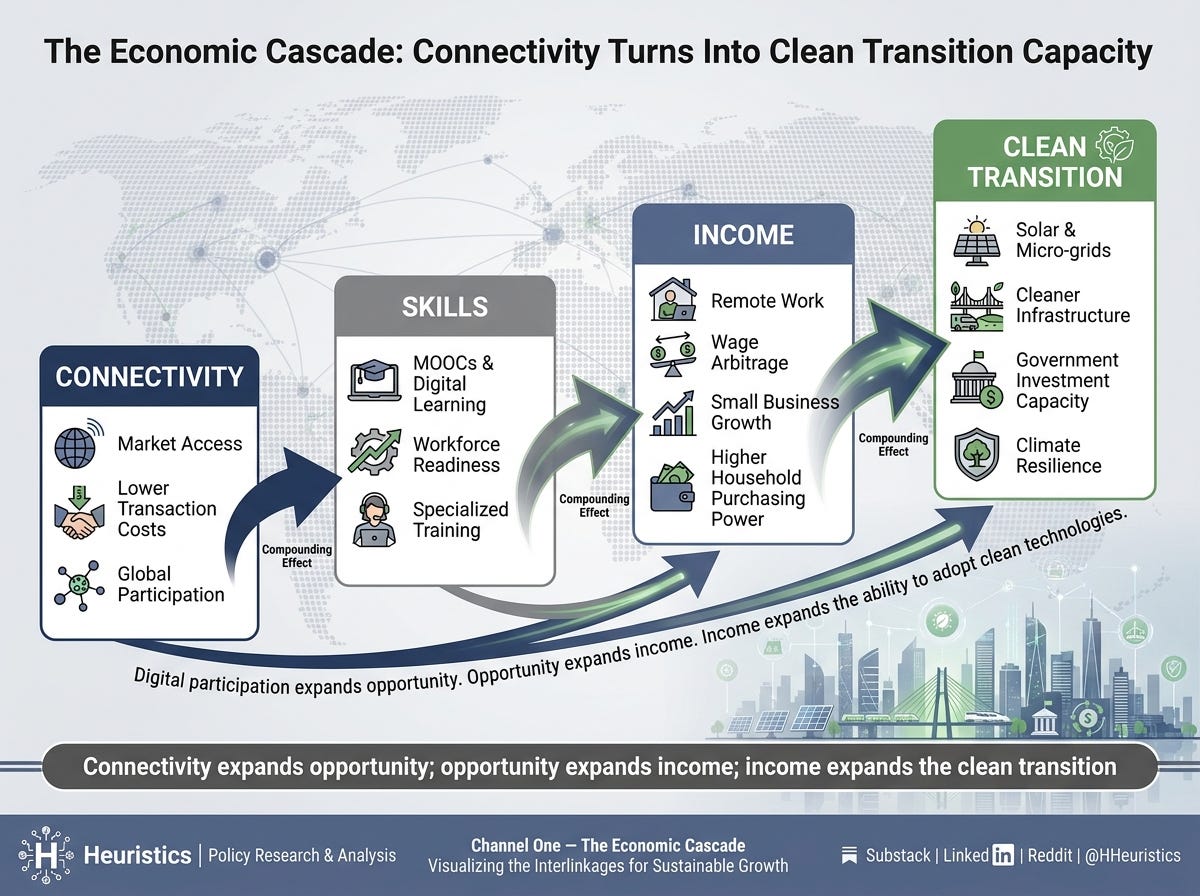
The economic cascade is simple: connectivity expands opportunity, opportunity expands income, income expands the clean transition.
IV. Channel Two — The Epistemic Cascade
Connectivity → Informed Citizens → Collective Intelligence → Better Governance → Faster Solutions
A. Information Asymmetry as Poverty
A farmer exploited by an intermediary, a patient who delays care, a voter who only receives state media — these are failures of information, not just economics. Each correction is a small repair to a market or social system. Multiply that across billions of decisions and the effect becomes civilisational.
B. Collective Intelligence at Scale
A connected world doesn’t just produce better‑informed individuals. It produces a new kind of intelligence: distributed, participatory, and global.
Citizen science platforms generate real‑time environmental data. iNaturalist maps biodiversity at planetary scale. Wikipedia remains the largest collaborative knowledge project in history.
Most human intelligence is currently excluded from formal knowledge production. Connectivity unlocks that latent capacity.
C. Accountability and Governance
Governance quality is a function of what citizens can observe, understand, and contest. Connected populations are harder to corrupt and easier to mobilise. Accountability operates vertically (citizens vs. governments) and horizontally (global civil society visibility).
AI‑augmented deliberation shows early promise: structured digital dialogue can produce policy positions that are both representative and technically informed.
D. Scientific Acceleration
Open access publishing, preprint servers, and collaborative research networks compress discovery‑to‑application timelines. AI quality depends on the breadth of human knowledge available to train on. A fully connected knowledge commons produces better AI, which accelerates science further.
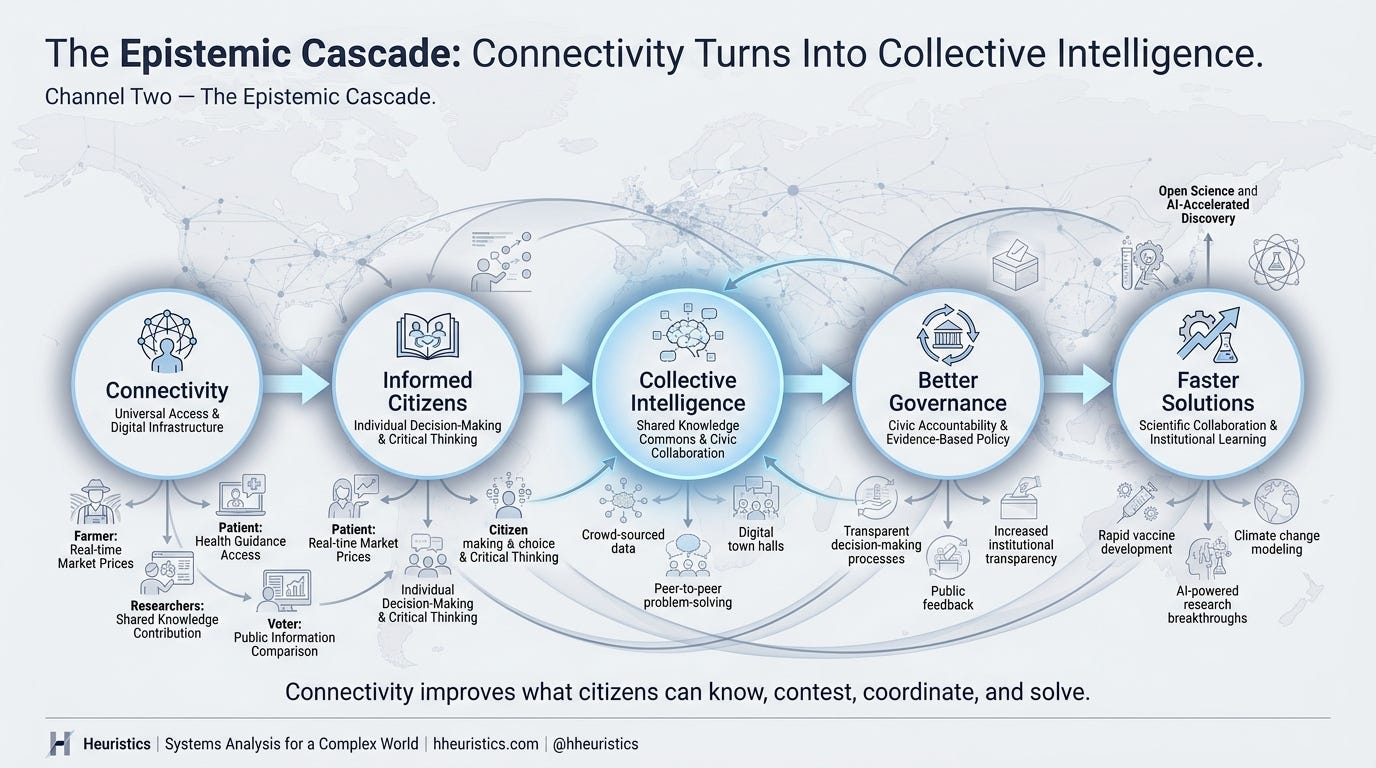
This is a positive feedback loop:
connectivity → collective intelligence → better AI → faster science → better solutions → better infrastructure.
V. The Honest Complication
Access is not the same as informed.
The same infrastructure that carries Wikipedia carries misinformation. Platforms optimised for engagement reward outrage over accuracy. Four distinct problems must be solved:
Access — are you online?
Literacy — can you evaluate what you read?
Architecture — are platforms designed to inform or inflame?
Language — is quality content available to you?
Universal connectivity without information quality could produce a world where more people are more confidently wrong — potentially worse than no information at all.
And the splinternet looms: a fractured internet produces fractured epistemic commons, which produce fractured coordination capacity.
This is not a reason to abandon the project. It is a reason to treat information architecture as infrastructure.
VI. Governments as Diffusion Nodes
The private sector will not close the diffusion gap. The economics of the last mile are negative in low‑income contexts.
The state’s role is not to build the internet — it is to create the conditions under which connectivity reaches everyone:
Spectrum allocation
Shared infrastructure investment
Digital ID systems
Broadband subsidies
School connectivity mandates
Rwanda’s national broadband strategy is a working archetype. Governments that route connectivity, skills, and digital tools to underserved populations don’t just provide welfare — they expand the productive base of the economy and the epistemic base of democracy simultaneously.
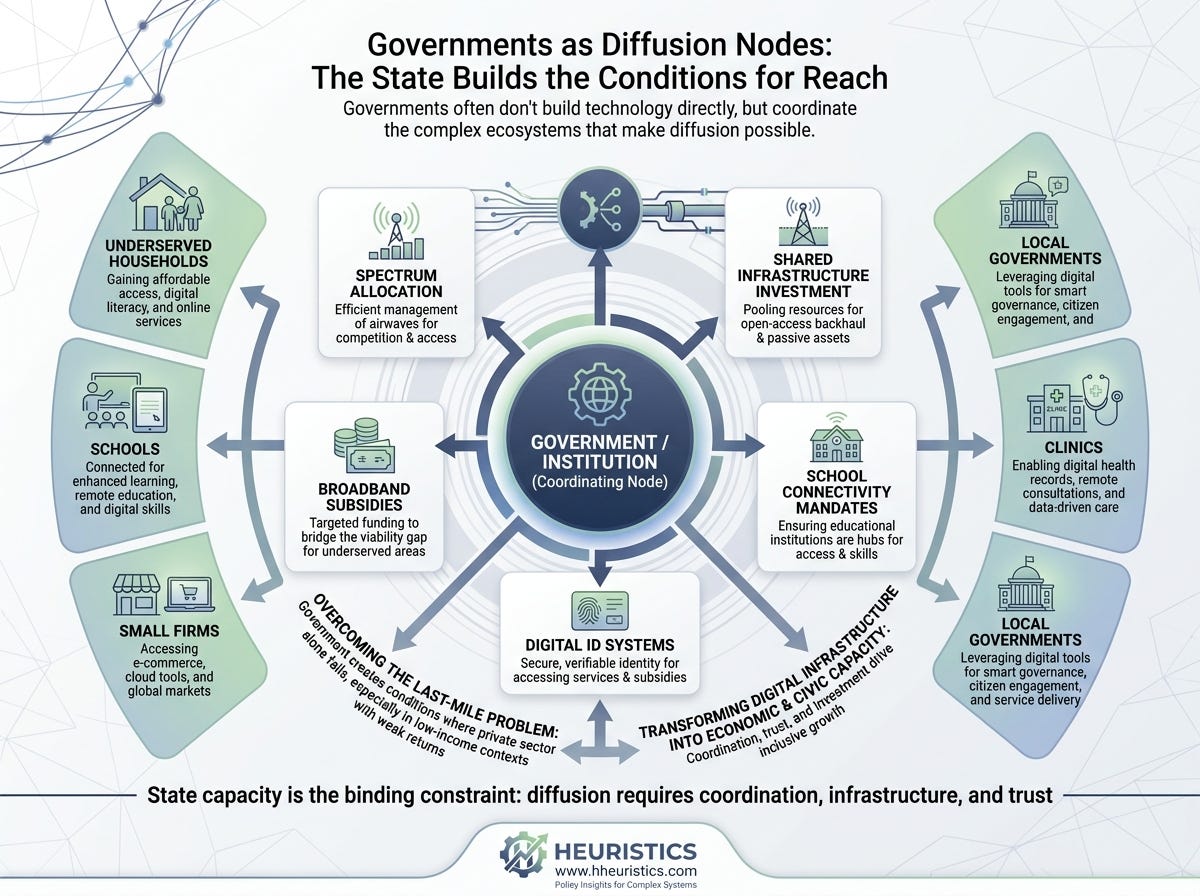
State capacity is the binding constraint. You cannot run a diffusion strategy without a functional state.
VII. Synthesis — A Civilisational Infrastructure Argument
The economic and epistemic cascades reinforce each other.
Rising incomes create political demand for better governance. Better governance produces better information environments. Better information environments produce smarter collective decisions about energy, health, and development.
Humanity’s biggest remaining problems — climate change, pandemic preparedness, institutional failure, resource depletion — all have known solutions. What they lack is coordinated global action. Coordinated global action requires a shared, accurate understanding of what is happening.
That shared understanding cannot exist while 2.6 billion people remain excluded from the information commons.
Universal connectivity is not a luxury. It is the infrastructure condition for civilisational self‑governance.
VIII. The Diffusion Imperative
We have the solutions. The question is whether we can deploy them fast enough, broadly enough, before the windows close.
Technology diffusion is the leverage point — the intervention that makes all other interventions more effective.
Impact = Optimisation × Diffusion × Use.
Optimisation is largely solved. Use is growing. Diffusion is the gap.
Closing it is the work.
This is the first moment in history when the entire human species could, in principle, share the same factual commons. What we do with that possibility will determine the trajectory of the coming decades.